For Iranians living abroad, sending financial support to family in Iran can become one of the most frustrating parts of managing life across two countries.
A student in London may need to help a parent with living expenses.
An engineer in Toronto may need to send money home for a household bill.
A family in Sydney may need to support relatives in Tehran, Shiraz, Mashhad, Isfahan, or another city.
An Iranian professional in the United States may need to make a regular family remittance while having no practical way to send an ordinary international bank transfer into an Iranian bank account.
The obvious question is therefore straightforward.
What is the cheapest way to send money to Iran?
The financially correct answer is more complicated than comparing the advertised transfer fee on two websites.
The cheapest route is not necessarily the service displaying the lowest commission.
It is the route that lets you deliver the required amount of domestic currency to the intended recipient at the lowest total economic cost while keeping the operational, legal, compliance, fraud, and settlement risks within an acceptable range.
This distinction matters because the total cost of a remittance can include an explicit transfer fee, a foreign-exchange spread, crypto purchase costs, network costs, payment-provider charges, intermediary deductions, and the economic cost of delays or failed transfers.
A service advertising “zero commission” can therefore be more expensive than another provider charging a visible fee if the first provider gives the customer a materially worse exchange rate.
That is why the phrase lowest fee money transfer to Iran should always be interpreted as a total-cost question rather than a sticker-price question.
There is an additional complication.
Iran sits inside a highly restricted international financial environment.
FATF currently classifies Iran as a high-risk jurisdiction subject to a call for action and urges jurisdictions to apply enhanced due diligence and, in the most serious circumstances, countermeasures. FATF also specifically notes that personal remittances should be handled on a risk-sensitive basis rather than assumed to be identical to all other flows.
This means that the practical question is not simply how fast money can move.
The more useful question is how value can move from the sender's country to the recipient's everyday Iranian banking environment in a way that is transparent, operationally reliable, cost-efficient, and compliant with the rules applicable to the sender, the payment providers, and the transaction.
Why is sending money to Iran fundamentally different?
In a typical international corridor, a customer can send money from one bank to another through established correspondent banking relationships.
The sender's bank debits the originating account.
A payment message is transmitted.
One or more correspondent institutions may participate in settlement.
The receiving bank credits the beneficiary.
The customer may never think about the underlying infrastructure.
Iran is different because sanctions, banking restrictions, correspondent-banking constraints, and enhanced compliance controls can disrupt the standard route.
SWIFT itself is a financial messaging network rather than a bank or a settlement account, and its historical restrictions on certain Iranian financial institutions illustrate why an ordinary direct international wire should not be assumed to work simply because both parties have bank accounts. The availability of any particular banking channel depends on the institutions, jurisdictions, applicable sanctions, and legal basis for the payment.
That distinction is important for anyone searching for the cheapest way to transfer money to Iran from USA UK Canada Europe Australia.
The answer can be different by sender country.
The answer can also be different by payment size.
It can change depending on whether the recipient needs cash, a local Iranian bank account deposit, or a Shetab debit card transfer.
It can change depending on whether the sender already owns USDT or needs to purchase it first.
And it can change based on whether the sender values maximum speed, maximum traceability, maximum simplicity, or minimum total cost.
What is the biggest mistake people make when comparing transfer fees?
Most people start by asking:
“How much is the transfer fee?”
That question is necessary but incomplete.
The more useful question is:
“How much do I have to spend in my home currency for my recipient to receive a fixed amount of domestic currency?”
Suppose one provider charges a visible fee of 0.5%.
Suppose another provider advertises no commission.
If the first provider applies a tight FX rate while the second provider applies a materially wider spread, the supposedly “free” provider may cost more.
This is why professional remittance analysis focuses on all-in cost.
The all-in cost is the amount of economic value the sender sacrifices to create a specified amount of value for the recipient.
Nominal fee versus real remittance cost: what is the difference?
A nominal fee is the explicit charge shown by the provider.
It may be a fixed amount.
It may be a percentage of the transfer.
It may be tiered according to the transfer size.
Or it may be zero.
But the nominal fee is only one component of the cost.
A more complete framework is:
Total economic cost formula (real remittance cost)
Real Cost = F + (A × s) + N + O
F explicit fees, A transfer amount, s FX spread (%), N network cost, O funding cost and intermediary deductions. All terms are measured in one currency.
The formula is conceptual rather than an accounting rule.
Its purpose is to force the comparison to include costs that are easy to ignore.
What is the foreign exchange (FX) spread trap?
The FX spread is one of the most important reasons a “cheap” remittance can be expensive.
Suppose the market reference rate implies that the recipient should receive approximately 100 units of local value for every 1 unit of foreign currency.
A provider may instead convert at 95.
Even if the provider charges zero commission, the customer is economically giving up approximately 5% relative to that benchmark.
If the customer sends the equivalent of 1,000 units of foreign currency, a 5% spread represents approximately 50 units of economic value before any other charges.
If the spread is 10%, the difference becomes approximately 100 units.
These are illustrative calculations rather than claims about any particular provider.
The essential lesson is that a large transfer magnifies even a modest-looking pricing difference.
Why can a 0% advertised fee still be expensive?
Consider a hypothetical transfer with three providers.
| Provider | Advertised Fee | Illustrative FX Spread | Economic Cost Before Other Charges |
|---|---|---|---|
| Provider A | 0% | 4% | Approximately 4% |
| Provider B | 0.5% | 1% | Approximately 1.5% |
| Provider C | 1% | 0.25% | Approximately 1.25% |
In this simplified scenario, Provider C has the highest visible fee and the lowest total economic cost.
That is the central concept behind the phrase real cost of remittance.
Why does the spread matter even more as transfer size increases?
Suppose a sender moves $100.
A 2% spread represents about $2.
On $1,000, the same spread represents about $20.
On $5,000, it represents about $100.
On $10,000, it represents about $200.
On $50,000, it represents about $1,000.
The arithmetic is simple, but the financial implication is substantial.
A provider whose pricing is only slightly less competitive can become materially more expensive for recurring or high-value family remittances.
How do intermediary bank charges erode your transfer?
Traditional cross-border payments may involve more than one financial institution.
The originating institution may charge a wire fee.
A correspondent bank may impose a deduction.
The receiving bank may impose an incoming payment fee.
There can also be differences between “sender pays all fees” and “shared fees” structures depending on the payment rail.
For a difficult corridor, there is a further complication.
A payment can be delayed for compliance review or rejected before reaching the recipient.
A theoretically cheap route is not economically attractive if the customer must repeatedly retry failed transfers.
Why does the legal and compliance layer matter?
Money-transfer decisions involving Iran must be analyzed in the context of sanctions and anti-money-laundering requirements applicable to the sender and the institutions involved.
There is no globally uniform rule that makes all transfers to Iran either universally prohibited or universally permissible.
For example, the U.S. Office of Foreign Assets Control states that certain noncommercial personal remittances to or from Iran are authorized under specified conditions, but it also explains that the authorization has limitations and that U.S. persons may not simply deal directly with money services businesses or hawalas in every circumstance.
This is precisely why users should avoid simplistic statements such as “all transfers to Iran are illegal” or “crypto bypasses sanctions.”
Both statements are too broad.
The legal status of a particular transaction depends on the facts.
Understanding FATF guidelines and Iran's financial status
FATF's June 19, 2026 statement continues to identify Iran as a high-risk jurisdiction subject to a call for action.
FATF states that such jurisdictions have significant strategic deficiencies in measures designed to combat money laundering, terrorist financing, and proliferation financing.
It calls for enhanced due diligence and, in the most serious cases, countermeasures.
At the same time, FATF's June 2026 language specifically recognizes that personal remittances should be handled on a risk-sensitive basis.
For ordinary consumers, the practical lesson is simple.
Do not assume that a money-transfer method becomes legally safe merely because it uses a blockchain.
Do not assume that a bank transfer becomes unlawful merely because the destination is Iran.
Instead, determine what legal framework applies to the transaction you are actually making.
How does sending money to Iran from the United States work?
U.S. users face a particularly important distinction between personal remittances and commercial or otherwise restricted transactions.
OFAC's official FAQ explains that certain noncommercial personal remittances to or from Iran can be authorized under 31 CFR 560.550, subject to limitations.
The same guidance makes clear that U.S. persons cannot simply assume they can directly transact with any money services business or hawala they choose.
This means a U.S. user should pay close attention to the legal role of the intermediary rather than focusing exclusively on the advertised fee.
How does sending money to Iran from Australia work?
Australia provides another useful example of why “crypto equals invisible” is an unsafe assumption.
The Australian Sanctions Office published a March 3, 2026 advisory specifically addressing sanctions risks associated with incoming funds from Iran.
The advisory notes that Australian banks, remitters, and Virtual Asset Service Providers may observe increased inbound funds linked directly or indirectly to Iran and may face elevated sanctions risks depending on the origin of funds and the persons or sectors involved.
For Australian users, the lesson is straightforward.
A crypto-funded transfer can still exist within the compliance perimeter of regulated financial institutions.
Using a blockchain does not remove AML or sanctions obligations.
How does sending money to Iran from the UK and Europe work?
Users in the UK and European jurisdictions should similarly consider the sanctions regime applicable to their institution and transaction.
Financial institutions routinely use transaction monitoring, customer due diligence, sanctions screening, and enhanced review processes.
Therefore, attempting to disguise the destination, obscure the purpose, or use inaccurate account information is not a sound strategy for reducing risk.
The appropriate objective is compliant payment processing rather than concealment.
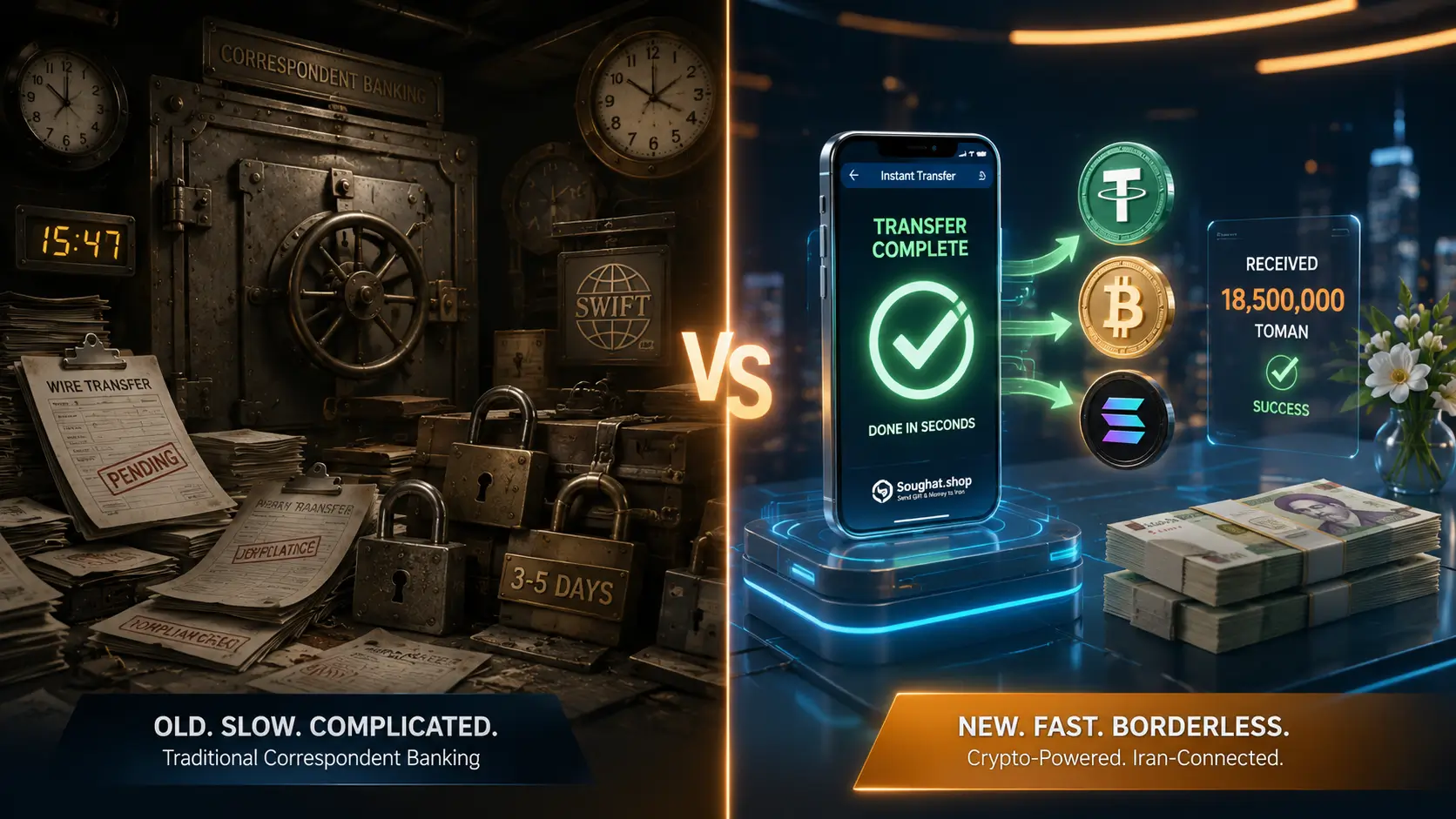
Method 1: Traditional Sarafi or exchange-house transfer
Traditional Iranian exchange businesses can be convenient because the customer is not required to navigate the technical details of the Iranian banking system or blockchain networks.
The sender typically gives money or value to the intermediary outside Iran.
The intermediary or its network arranges for a corresponding amount of domestic currency to be paid to the recipient inside Iran.
This model can be operationally effective when the provider is established and the transaction is handled lawfully.
However, not all providers have the same level of documentation, transparency, licensing, compliance infrastructure, or dispute-resolution procedures.
The pricing problem
A traditional exchange service can earn revenue through an explicit fee.
It can also earn revenue through its exchange-rate spread.
It can use a combination of both.
In a competitive market, the customer should therefore request the exact amount that will reach the recipient rather than relying on a statement such as “our commission is zero.”
The operational problem
Some traditional remittance networks depend heavily on manual reconciliation.
Manual processes can work extremely well when handled by experienced professionals.
But they also create dependence on staff availability, internal ledgers, liquidity management, and counterparties.
The documentation problem
A formal receipt, order identifier, payment confirmation, beneficiary record, and proof of settlement are valuable when a customer needs to demonstrate what happened.
Customers should be cautious when an intermediary cannot clearly explain the payment flow or refuses to provide reasonable documentation.
Method 2: Official bank wire and SWIFT transfers
The idea of sending an ordinary international bank wire directly into an Iranian bank account is appealing because it appears familiar.
In practice, the Iran corridor is not equivalent to a standard transfer between two unrestricted banking systems.
SWIFT is a messaging infrastructure, and historical restrictions have affected the ability of certain Iranian financial institutions to access it.
More importantly, the transfer must also satisfy sanctions, correspondent-bank, compliance, and receiving-bank requirements.
As a result, an ordinary consumer should never assume that a conventional international wire can simply be initiated to any Iranian bank account.
Possible costs
Potential cost components can include:
- Originating bank wire fee.
- Correspondent bank deductions.
- Receiving-bank fees.
- FX conversion costs.
- Compliance-review delays.
- Potential return or rejection costs.
The biggest weakness
The biggest weakness of a direct wire is not necessarily the nominal fee.
It is uncertainty over whether the route is operationally available and legally permitted in the first place.
Method 3: Global fintech apps (Wise, Revolut, PayPal)
Global fintech brands are often the first tools people consider because they are inexpensive and easy to use for many international corridors.
Iran is a notable exception.
Wise
Wise's official support page currently lists Iran among the countries and regions it does not support.
Wise states that users cannot send or receive money to or from unsupported jurisdictions and warns that using Wise from unsupported locations may lead to account restrictions, cancelled or refunded transfers, or additional information requests.
Therefore, Wise should not be presented as a standard direct remittance route into Iran.
Revolut
Revolut's official support documentation currently lists Iran among unsupported countries for international transfers.
Its documentation also lists IRR among unsupported international-transfer currencies.
Again, the lesson is that having a Revolut account in Europe or another supported market does not automatically mean that the user can send an international transfer directly into Iran.
PayPal
PayPal service availability is country-specific.
Users should never assume that a PayPal account opened in a supported country creates an unrestricted payment route into Iran.
Where a platform does not support Iran as a destination, attempting to circumvent country restrictions can expose the account to review or restrictions.
Western Union and MoneyGram
Large money-transfer networks have broad international coverage, but coverage is not universal.
Availability depends on destination, source country, transfer type, sanctions restrictions, payout method, and the provider's own policies.
The fact that a service operates in a particular country does not mean it provides a direct payout rail to every Iranian bank account.
Remitly and similar services
The same principle applies to other consumer remittance applications.
A provider can be excellent for a corridor such as the United States to Mexico and still have no usable corridor to Iran.
The correct process is to check current destination availability rather than assume that a successful transfer to one country implies support for another.
Paying Soughat Shop from PayPal, Revolut or Cash App
None of these apps sends money to Iran directly, but they can be the funding source for a Soughat Shop order. Instead of sending money “to Iran”, you buy a digital asset inside the app and pay the invoice; your family receives Toman on a Shetab card.
- PayPal: buy PYUSD (PayPal's dollar stablecoin) or Bitcoin inside PayPal and send it to our wallet. Crypto transfers to external wallets are available for U.S. PayPal accounts. Guides: Pay with PayPal and PYUSD on Solana and Pay with PayPal via Bitcoin.
- Revolut: where the crypto feature is available for your country and plan, you can pay with USDT, SOL or BTC. Guide: Pay with Revolut.
- Cash App: buy Bitcoin (on-chain or Lightning) and pay the invoice. Guide: Pay with Cash App. Check your provider's terms and your local laws before paying.
What is PYUSD and why does Soughat Shop support it?
PYUSD is PayPal's U.S.-dollar stablecoin, valued at 1 USD, so it does not fluctuate between the moment you see the invoice and the moment you pay. Soughat Shop supports PYUSD alongside USDT and SOL, and treats 1 PYUSD as exactly 1 USD on the invoice.
Important: send USDT and PYUSD to Soughat Shop only on the Solana (SPL) network. Sending them over TRC20 or ERC20 can result in a permanent loss of funds. If PayPal shows a network fee at confirmation, buy slightly more so the received amount is not below the invoice.
See all supported wallets and apps for step-by-step payment guides.
Why trying to hide the destination in a payment reference is high-risk
Some users assume that they can reduce the risk of a blocked transfer by using a generic payment reference or concealing the true destination.
This is not responsible financial behavior.
A transaction can be screened using more than the free-text reference field.
Financial institutions can evaluate customer identity, beneficiary identity, transaction history, account behavior, payment routing, sanctions data, counterparties, and other risk signals.
False information can create a separate compliance problem.
The correct objective is a legitimate transaction through a provider that is authorized to process the transaction rather than an attempt to disguise its nature.
Method 4: Carrying physical cash with travelers
Physical cash appears simple because it removes many digital intermediaries.
But it introduces an entirely different category of risk.
The first risk is physical loss.
The second is theft.
The third is border compliance.
The fourth is the practical problem of finding someone traveling at exactly the right time.
The fifth is scalability.
The sixth is documentation.
Cash declaration rules
Cash and negotiable instruments can be subject to declaration requirements, thresholds, and border rules that vary by jurisdiction.
A traveler should never assume that carrying a large amount of currency across a border is automatically permitted merely because the cash belongs to them.
The relevant threshold and declaration requirement depend on the country and circumstances of travel.
Why travelers are unreliable for emergencies
A traveler-based transfer depends on another person's itinerary.
If your family needs funds tonight, a traveler may be unavailable.
If the traveler cancels their trip, the transfer fails.
If the traveler has an unexpected problem, the transfer is delayed.
For recurring family support, that level of dependency can become impractical.
Method 5: Direct crypto transfers to family wallets
Crypto can remove some banking barriers.
But there is an important difference between a blockchain transfer and a finished family remittance.
Sending USDT to a family member's wallet does not automatically mean the family has domestic purchasing power.
The recipient still needs a way to receive, understand, convert, and use the asset.
That can be manageable for experienced crypto users.
It can be frustrating for elderly parents.
The elderly-parent problem
Consider a parent who rarely uses financial applications.
That person may need to understand the difference between an address and a network.
They may need to safeguard a recovery phrase.
They may need to learn how to deposit an asset into an exchange.
They may need to complete identity verification.
They may then need to sell the asset and withdraw domestic currency.
Every extra step creates another point of failure.
The network-selection problem
USDT can exist on multiple blockchain networks.
The sender must select the network supported by the recipient's wallet or platform.
The existence of an asset with the same ticker does not mean that every transfer endpoint accepts every network.
The conversion problem
The recipient may not sell at the same rate the sender expected.
The local market can move.
The exchange can apply a spread.
Liquidity can differ.
The recipient may also face temporary withdrawal limitations or operational restrictions.
Method 6: Dedicated crypto-to-domestic Shetab rails (Soughat Shop)
A specialized remittance model can solve a different problem.
Instead of asking the family member to become a crypto user, the sender uses a crypto payment as the funding mechanism while the service handles the domestic settlement leg.
This creates a two-layer transaction.
Layer one is the cross-border funding transaction.
Layer two is the local domestic payout.
For the sender, the funding side may use USDT, BTC, or another supported digital asset.
For the recipient, the result can be a normal local Iranian bank account deposit or Shetab debit card transfer.
The recipient therefore does not need to operate a crypto wallet merely to receive family support.

How Soughat Shop solves the Iran remittance equation
Sending money to Iran usually fails on one of three points: the sender cannot use a banking route, the final price is unclear, or the recipient has to handle crypto. At Soughat Shop we split the problem: the sender pays with digital assets and the recipient receives Toman. The blockchain stays behind the scenes; the destination is still an Iranian bank card or account.
This is how an order works on our Cash Remittance Card to Card Transfer page:
- Choose the amount: from 1 to 100 million Toman in 1-million steps (minimum order $25).
- Enter the recipient: card number, IBAN or account, and the account holder's name.
- See one final invoice in USD, EUR, GBP or SEK.
- Pick the payment asset: USDT, PYUSD or SOL (other assets such as Bitcoin can be arranged with support).
- Pay: get the wallet address from support on WhatsApp and send the invoice amount.
- Confirmation and deposit: after your payment is confirmed, Toman is deposited to the recipient's Shetab card and an official bank receipt is sent to you.
- Track it on the order tracking page.
Our price is one final, live number per 1,000,000 Toman (currently $5.99). No separate service or payout fee is added to the invoice; the only cost outside it is the very small Solana network fee in your own wallet.
Regular senders can use our 15% first-order discount (it covers remittances) and the Soughat Shop dollar wallet: top up once, then pay later orders from the balance without a new on-chain transfer each time.
To be transparent: no financial route is “unmonitored”. Your bank or exchange may review transactions under AML and KYC rules, so always use accurate information and keep your receipts.
Why blockchain network fees can be extremely low
One reason blockchain-funded remittances can be efficient is the low cost of some blockchain transactions.
On Solana, the official fee documentation currently states a base fee of 5,000 lamports per signature, with an optional prioritization fee.
The fee is charged to the transaction fee payer.
This can be extremely small in absolute terms.
However, the existence of a low blockchain fee does not prove that the entire remittance is cheap.
The sender may still pay a crypto exchange spread.
The sender may pay a withdrawal fee.
The provider may charge for conversion or settlement.
Therefore, blockchain transaction cost should be viewed as one part of the total cost structure.
TRON network and USDT transfer mechanics
TRON uses a resource model based on Bandwidth and Energy.
The official developer documentation explains that Bandwidth relates to transaction size and Energy relates to smart-contract execution.
Users can obtain resources through staking or delegated resources, and when available resources are insufficient, TRX can be burned to cover the shortfall.
Therefore, it is more accurate to say that TRON-based USDT transfers can be inexpensive than to claim that every USDT-TRC20 transaction costs a fixed number of cents.
Bitcoin transaction fee dynamics
Bitcoin transaction costs are not fixed according to the amount being transferred.
The fee market depends on transaction size and network demand.
This matters because a large bitcoin transfer is not automatically expensive and a small bitcoin transfer is not automatically cheap.
For time-sensitive remittances, users should therefore compare the actual network conditions and exchange withdrawal fee rather than rely on a generic statement that Bitcoin is expensive or cheap.
Why USDT is practical for cross-border family support
USDT is designed as a dollar-denominated stablecoin rather than as a volatile asset such as Bitcoin.
That makes it operationally attractive when the sender wants the transferred value to track the U.S. dollar over a short settlement period.
But stablecoins are not risk-free.
There are issuer risks, platform risks, custody risks, smart-contract risks, network risks, and user-error risks.
USDT should therefore be treated as a financial instrument within a payment workflow, not as magic digital cash.
The definitive mathematical test for remittance cost
Suppose your family must receive exactly a fixed amount of domestic currency.
Ask each service to tell you how much foreign currency you must spend to create that exact destination amount.
Then compare the results.
That is more useful than comparing advertised commission percentages.
For example:
| Scenario | Amount the Recipient Must Receive | Foreign Currency Actually Spent | Approximate Economic Cost |
|---|---|---|---|
| Service A | Fixed destination amount | $1,000 | Baseline |
| Service B | Same destination amount | $1,020 | Approximately 2% more |
| Service C | Same destination amount | $1,050 | Approximately 5% more |
Even if Service C announces zero commission, its all-in economic cost is higher in this example.
How to calculate the effective remittance cost ratio
Let:
P be the amount paid by the sender.
R be the destination amount actually received.
M be the market-reference value of the destination amount expressed in the sender's currency.
A simplified effective cost ratio can then be expressed as:
Effective cost = (P - M) / M
This is not a universal accounting formula.
It is a comparison framework.
If Provider A requires $1,010 to create an outcome that would have a market-reference value of $1,000, its excess cost is approximately 1% under that benchmark.
Why a live executable quote beats a static fee page
Exchange rates move.
Crypto prices move.
Liquidity conditions change.
Network fees can change.
Therefore, the most useful price comparison is the actual executable quote at the time the transfer is initiated.
A static “1% fee” page cannot tell you whether the provider's exchange rate is competitive at 2 p.m. today.
What “lowest fee money transfer to Iran” should actually mean
A credible low-fee provider should make it possible for the user to determine at least five things.
- The amount the sender must pay.
- The amount the recipient will receive.
- The exchange rate or conversion method.
- The applicable service and network fees.
- The expected settlement time.
The more of these variables a provider makes transparent, the easier it becomes for the customer to compare the actual economics of the transaction.
The reality of FX spreads in informal corridors
Wide spreads can occur.
But there is no responsible reason to claim that all Sarafis, all crypto providers, or all Iranian remittance services systematically hide a 5% to 10% spread.
Pricing differs by corridor, provider, volume, liquidity, market conditions, customer relationship, and transaction size.
The right analytical approach is to measure the spread.
Do not assume it.
How to measure the real spread yourself
Start with a transparent benchmark.
This could be an observable institutional FX reference, a reputable market quote, or another clearly identified benchmark appropriate to the currencies being compared.
Then compare the provider's executable rate.
The difference is your starting point for evaluating the spread.
If the provider's rate is substantially worse than your benchmark, ask why.
The answer may be legitimate operating cost.
It may also reflect commercial margin.
The point is not that margin is inherently bad.
The point is that the customer should understand it.
Why the cheapest route is not always the safest
Cost and risk can move in opposite directions.
A poorly documented intermediary may offer a fantastic exchange rate.
That does not automatically make it the best option.
The provider could lack meaningful dispute resolution.
It could have weak internal controls.
It could depend on unknown third parties.
It could expose the customer to legal or account risks.
A more expensive but transparent provider can therefore be economically superior when risk is included in the analysis.
Expected-loss thinking in cross-border transfers
A useful way to think about risk is expected loss.
Suppose one method saves $20 on every transaction but has a small probability of creating a major loss or lengthy dispute.
Another method costs $10 more but has a better documented process and clearer recourse.
The second method may have lower expected cost once the probability and consequence of failure are considered.
This is why the safest way to transfer funds to family in Iran should not be defined by the blockchain alone.
Safety is the combined result of technology, custody, compliance, operational controls, documentation, beneficiary verification, customer support, and dispute resolution.
What does “safe” actually mean in a remittance service?
For a consumer, a safer payment route usually has the following characteristics.
- Clear identification of the service provider.
- Transparent pricing.
- Clear beneficiary information requirements.
- Secure payment infrastructure.
- Documented payment confirmation.
- Clear refund or dispute procedures.
- Compliance processes appropriate to the service.
- Reliable customer support.
- Strong controls over payment instructions.
Why Soughat Shop’s hybrid model is ideal for families in Iran
A conventional crypto remittance puts a large part of the work on the recipient.
A dedicated crypto-to-bank remittance service can move that complexity into the provider's infrastructure.
For the recipient, the outcome can become simple.
A payment arrives in the domestic banking environment.
The recipient does not have to understand blockchain confirmations.
The recipient does not have to calculate network fees.
The recipient does not have to choose between Solana and TRON.
The recipient does not have to convert USDT into domestic currency.
The recipient does not need to maintain a crypto exchange account purely to receive family support.
This does not eliminate every risk.
It does, however, reduce the number of technical decisions that the recipient must make.
Can I send money to Iran without holding an Iranian bank card?
For many members of the diaspora, the real problem is not the recipient's bank card.
The real problem is the sender's lack of a practical Iranian banking account.
A blockchain-funded remittance model can separate these requirements.
The sender can pay using a supported crypto asset.
The recipient can receive through a local Iranian bank card or bank account.
In other words, the sender does not necessarily need to hold or use an Iranian bank card simply to fund the cross-border payment.
That is one of the clearest practical benefits of crypto-funded remittance infrastructure.
How Soughat Shop's verified remittance process works
You select a cash-remittance amount on our remittance page, receive the wallet address from support, complete the crypto payment, and our team verifies the payment before the Toman amount is deposited to the recipient's Iranian bank card.
The service is accessible to users in markets including the United States, Canada, Europe, Australia and the United Kingdom.
Always check current terms, supported countries, payment options, limits and applicable laws at the time of your transaction.
Step-by-step remittance workflow with Soughat Shop
Step one choose the destination amount
Begin by deciding exactly how much the recipient needs to receive.
A fixed destination amount makes cost comparison much easier.
You should not compare one provider for a $1,000 sender-side payment with another provider for a fixed destination payout.
Compare like with like.
Step two confirm the beneficiary information
Enter the recipient's information exactly as requested by the service.
Depending on the workflow, this may include a bank-card number, account information, IBAN, beneficiary name, or other identifying information.
Always verify every digit before final submission.
Step three review the quote
Check the amount you pay.
Check the destination amount.
Check the quoted rate.
Check any explicit fee.
Check the supported network.
Check the estimated settlement time.
Step four choose the crypto funding method
Use only the digital asset and network explicitly supported by the payment instructions.
If the order specifies USDT on a particular network, do not substitute a different chain simply because the token ticker is identical.
Step five verify the destination address
Copy the wallet address carefully.
Check the first and last characters.
Confirm the network.
Confirm the asset.
Confirm the amount.
For larger transfers, consider a small test transfer where operationally appropriate.
Step six complete the crypto payment
Send the exact amount requested.
Retain the blockchain transaction identifier.
A transaction hash can later be used to verify that the payment was broadcast and confirmed on the relevant network.
Step seven wait for service verification
Blockchain confirmation is not identical to domestic bank settlement.
The service may need to detect the payment, reconcile the order, perform internal review, and then execute the domestic payout.
Step eight verify the domestic deposit
The final objective is not merely “the crypto transaction succeeded.”
The final objective is that the intended recipient receives the correct amount in their domestic banking environment.
Soughat Shop's public remittance description states that its process ends with a deposit to the recipient's Shetab-connected bank card.
Step nine retain documentation
Keep the order number.
Keep the payment confirmation.
Keep the blockchain transaction ID.
Keep the bank receipt or equivalent settlement evidence.
Keeping these records is useful for troubleshooting and personal financial documentation.
Which wallet or app can I pay with?
You do not need to be a crypto expert. Each popular wallet or app has its own step-by-step guide for paying a Soughat Shop order:
- PayPal with PYUSD (Solana): best for U.S. PayPal users
- PayPal with Bitcoin: U.S. and Canada
- Revolut: Europe, UK and Australia
- Cash App: U.S. and UK
- Venmo: U.S. residents
- Shakepay and Interac: Canada
- CoinSpot and PayID: Australia
- Coinbase: buy with card or Apple Pay worldwide
- Kraken: Europe, UK and U.S.
- Binance and Bybit: worldwide
- Phantom Wallet: the fastest, lowest-fee Solana wallet
Other wallets, such as Trust Wallet, work too if they support the Solana network. Read the general rules in our crypto guide.
Why official domestic bank receipts matter
A blockchain transaction proves what happened on-chain.
A domestic bank receipt proves what happened on the payout side.
These are different forms of evidence.
A professional remittance workflow should make it possible to reconcile them.
Delivery speed: domestic Shetab settlement within 30 to 60 minutes directly to local Shetab debit cards
Our target is to deposit Toman to the recipient's Shetab card in under 30 minutes and within 1 hour at most after your payment is confirmed. This is stated on our remittance page and in our terms and guarantee.
That is a service-level target of Soughat Shop, not a universal property of blockchain-based remittances. Actual time depends on how fast you pay, network confirmation, order verification, the accuracy of the beneficiary details and the condition of the domestic banking system.
Keep your bank receipt and transaction ID, and follow the order on the tracking page.
24/7 global support across international time zones
A platform can provide customer support across time zones without every banking system operating identically around the clock.
This distinction matters.
Customer support availability is not the same thing as uninterrupted bank processing.
Users should verify the provider's current operating hours and settlement rules for their specific transfer.
What a 100% money-back guarantee should actually mean
A money-back guarantee is only as useful as its conditions, so here are ours: Soughat Shop's 100% money-back guarantee covers problems on our side, for example if the deposit is not made. It does not cover wrong information entered at checkout, such as an incorrect card number.
You can cancel for free before your payment is confirmed. Because crypto transactions are irreversible once confirmed on the blockchain, a full cancellation after confirmation and processing is not possible, so contact support immediately if something needs to change.
Read the full conditions in the terms and guarantee and the trust and security page.
Operational security versus cryptographic verification
Blockchain transfers are not automatically reversible.
If a user sends funds to the wrong address, the blockchain does not generally function like a credit-card chargeback system.
That makes payment verification critical.
It also makes legitimate service-provider selection important.
What blockchain transparency actually provides
On a public blockchain, transaction data can often be independently verified.
This can provide strong evidence about whether the blockchain payment occurred.
However, the chain does not by itself guarantee that the recipient of the service is reputable or that a commercial dispute will be resolved.
Blockchain transparency is therefore a useful layer of evidence, not a universal consumer-protection mechanism.
Comprehensive comparison of six remittance channels
| Transfer Method | Real Total Cost and Spread | Transfer Speed | Risk of Bank Account Freeze or Review | Sender Iranian Card Needed | Recipient Crypto Knowledge Needed | Security and Guarantee |
|---|---|---|---|---|---|---|
| Traditional Sarafi or informal exchange network | Highly variable; explicit fee and spread both matter | Often hours to one or more business days depending on provider and liquidity | Depends heavily on jurisdiction and payment path | Usually no | No | Depends on provider documentation, controls, and dispute policy |
| Official bank wire or SWIFT | Potential bank, correspondent, FX, and receiving charges | Variable | High sensitivity because Iran-related transactions can trigger enhanced review and sanctions screening | No | No | Strong banking controls, but route availability is the central issue |
| Wise | Not a practical direct Iran corridor because Iran is currently unsupported | Not reliable for Iran | Potential restrictions if used from unsupported countries or for unsupported transfers | No | No | Strong platform controls, but Iran is outside supported service scope. |
| Revolut | Not a supported direct Iran transfer corridor | Not reliable for Iran | Potential restrictions where transactions conflict with supported-country rules | No | No | Strong regulated-service controls, but Iran is currently unsupported for transfers. |
| PayPal and similar global wallets | Country-specific; Iran is not a standard direct consumer corridor | Not reliable for direct Iran settlement | Potential account review if activity violates country or service rules | No | No | Depends on provider terms and destination support |
| Traveler cash | Low visible fee but significant operational and physical risk | Depends on travel schedule | Border and declaration risk rather than ordinary bank-transfer risk | No | No | Cash has weak recovery characteristics after theft or loss |
| Direct crypto to family wallet | Crypto purchase + spread + withdrawal + network + conversion cost | Blockchain settlement can be fast; local cash-out varies | Depends on the services used and applicable rules | No | Usually yes | Strong blockchain settlement but greater recipient-side complexity |
| Dedicated crypto-to-domestic-account rail such as Soughat Shop | Must be measured from actual quote, including conversion and any service or network charges | Soughat Shop currently advertises under one hour; actual time can vary. | Still subject to applicable laws, provider controls, and source-of-funds requirements | Not necessarily for the sender | No, where the provider handles conversion and domestic payout | Potentially strong user experience when documentation, payout evidence, and refund terms are clear |
Why one size does not fit all in cross-border transfers
There is no single table row that is automatically “best” for every person.
A $50 emergency payment and a $20,000 family remittance are economically different transactions.
A sender in California faces a different regulatory framework from a sender in Melbourne.
A sender who already owns USDT faces a different cost structure from someone who must first purchase USDT through an exchange.
Therefore, the right conclusion is conditional.
The right method is the one whose total cost and risk profile match the specific transaction.
What makes a crypto-to-bank rail economically superior
A specialized crypto-to-bank rail can create value by minimizing the number of independent conversion steps.
Instead of:
- Buy crypto.
- Send crypto.
- Teach family how to receive crypto.
- Teach family how to sell crypto.
- Teach family how to withdraw domestic currency.
- Resolve any local exchange issue.
The model can become:
- Fund the transfer.
- Provide beneficiary details.
- Receive domestic payout.
This does not necessarily mean it has the lowest nominal fee.
It means it can have a lower total friction cost.
Quantifying the financial value of reduced friction
Economists sometimes focus only on explicit monetary costs.
Consumers experience additional costs.
Time spent learning crypto has value.
Time spent resolving a failed transaction has value.
Time spent waiting for a bank transfer has value.
Risk of making a technical mistake has value.
The operational simplicity of a remittance therefore has an economic dimension.
Why families in Iran prefer direct Shetab card deposits
For a recipient who already uses a domestic bank card every day, a bank deposit is familiar.
There is no new wallet to learn.
There is no blockchain address to verify.
There is no seed phrase to protect.
There is no token sale to execute.
There is no network choice to make.
The recipient simply receives funds in an environment they already understand.
Why senders abroad prefer crypto funding
For the sender, crypto can provide an alternative funding rail when a conventional bank-to-Iran transfer is not practically available.
It can also offer transparent blockchain transaction records.
It can allow cross-border funding without requiring the family member to become a crypto user.
Again, the benefit depends on the legality and supportability of the full transaction in the sender's jurisdiction.
Realistic claims versus misleading marketing in financial services
A high-quality financial website should avoid several claims.
- “Crypto can never be flagged by your bank.”
- “All transfers to Iran are legal.”
- “Crypto completely bypasses sanctions.”
- “Every transfer is guaranteed to arrive in less than one hour.”
- “We are always cheaper than every other provider.”
- “USDT transactions are risk-free.”
- “Blockchain payments are anonymous.”
Each of these statements is too absolute.
What credible commercial transparency looks like
A stronger and more credible claim is:
“Use crypto to fund an Iranian domestic payout without requiring the recipient to manage cryptocurrency.”
Another defensible claim is:
“Compare the final amount received against the amount you actually pay, rather than comparing transfer fees alone.”
This language is both more useful to the consumer and more defensible from a compliance perspective.
The importance of source-of-funds documentation
Customers making significant transfers should retain records showing where the money originated.
This can include bank statements, employment records, sale records, invoices, exchange purchase confirmations, or other lawful documentation appropriate to the circumstances.
The exact records required depend on the jurisdiction, amount, transaction type, and service provider.
Good documentation reduces uncertainty when a regulated institution asks reasonable questions.
Why structuring payments to avoid scrutiny increases risk
A common misconception is that a large transfer becomes safer if it is divided into many smaller transfers.
That assumption can be dangerous.
Financial institutions can look for patterns across transactions rather than evaluating every transaction in isolation.
Attempts to deliberately structure transactions to avoid compliance thresholds can create additional risk.
Customers should not design their payment behavior around avoiding legitimate compliance controls.
Card number versus IBAN (Shaba) in domestic payouts
For a domestic payout, the exact beneficiary information depends on the provider's supported settlement mechanism.
Some services use card-to-card settlement.
Others may require account or IBAN information.
The customer should follow the exact requirements of the service and verify the destination details before payment.
Why beneficiary pre-verification prevents failed transfers
The most avoidable remittance failures often occur because the recipient data is wrong.
A single incorrect digit can create a failed or delayed payment.
Users should verify the beneficiary name and banking destination independently before submitting the order.
How to evaluate a remittance quote in five seconds
Look at the left side of the transaction.
How much are you paying?
Look at the right side.
How much is your family receiving?
Then ask what explains the difference.
If the answer is transparent, you can evaluate it.
If the answer is hidden inside an unexplained rate, comparison becomes difficult.
How to evaluate a remittance quote in five minutes
Record the sender currency.
Record the target domestic amount.
Record the quoted FX rate.
Record the direct fee.
Record the crypto purchase price if applicable.
Record the blockchain/network fee if separately charged.
Record the expected arrival time.
Record the refund policy.
Then compare the same fields across all providers.
Economics of recurring monthly family support
For monthly remittances, the economics become easier to quantify.
Suppose a recurring transfer has an avoidable 1% spread difference.
On twelve monthly transfers of $1,000, the cumulative difference is approximately $120.
Over five years, assuming the same nominal values, that becomes approximately $600.
That is why a small pricing difference can become meaningful over time.
Emergency family support and the monetary value of speed
For an emergency transfer, the value of time can dominate the fee difference.
If one service costs $8 more but reliably delivers the domestic payout several hours sooner, the additional cost may be rational.
There is no universal utility function for a remittance.
The correct decision depends on what the sender is trying to optimize.
Optimal transfer strategies for small payments
Small transfers are especially sensitive to fixed fees.
A $3 fee on a $50 transfer is 6%.
The same $3 fee on a $500 transfer is 0.6%.
That is why a provider with a fixed minimum fee can become unattractive for very small remittances.
Optimal transfer strategies for large remittances
Large transfers are especially sensitive to spreads and compliance.
A 0.5% pricing difference on $20,000 is approximately $100.
A 2% difference is approximately $400.
A 5% difference is approximately $1,000.
At these levels, an apparently small pricing advantage becomes material.
The impact of volume-based pricing
Some financial services negotiate rates based on transfer volume.
Others apply fixed retail pricing.
A user sending $20,000 may therefore see a different effective rate from someone sending $200.
Customers should ask whether larger transactions qualify for a different quote.
Intraday liquidity and rate variations
Crypto markets move continuously.
FX markets move continuously.
Liquidity can vary.
Network congestion can vary.
Therefore, a quote that is competitive in the morning can be less attractive later in the day.
For price-sensitive customers, comparison should happen close to the actual payment time.
Building your personal remittance evaluation matrix
| Field | Value to Record | Why It Matters |
|---|---|---|
| Sender currency | USD, CAD, GBP, EUR, AUD, AED, etc. | Defines the funding side |
| Destination amount | Required domestic currency payout | Creates a fixed comparison target |
| Provider quote | Required sender-side amount | Core economic comparison |
| Explicit fee | Amount charged separately | Identifies direct cost |
| FX benchmark | Reference market rate | Allows spread analysis |
| Actual provider rate | Executable rate | Measures provider pricing |
| Crypto purchase fee | Exchange or payment-provider cost | Captures funding cost |
| Network fee | Blockchain transfer cost | Captures on-chain cost |
| ETA | Expected domestic settlement time | Measures speed |
| Refund terms | Conditions and timing | Measures recovery options |
Defining true domestic currency payout transparency
From a consumer perspective, the most useful definition is that the provider communicates the destination amount before the transaction is finalized.
The customer should know the expected domestic payout corresponding to the amount being paid.
Any difference caused by rate movement, service conditions, or settlement rules should be disclosed in advance rather than discovered after the transfer.
Regulatory agility and the need for updated financial content
Financial and sanctions information can change.
A corridor that works today may be unavailable next year.
A provider's supported-country list may change.
A regulator may issue new guidance.
A bank may change its compliance requirements.
For that reason, remittance content should be reviewed regularly rather than treated as evergreen marketing copy.
The role of interactive real-time FX calculators
A static article can explain the methodology.
A live quote system can answer the user's immediate question.
For example, the page could allow users to enter the amount they want to fund or the amount they want their family to receive.
The system can then display:
- Destination amount.
- Funding amount.
- Exchange rate.
- Applicable fees.
- Payment method.
- Estimated settlement time.
This converts educational content into a practical decision tool.
Elevating customer trust through structural transparency
Do not simply write “best rate guaranteed.”
Show how the rate is derived.
Do not simply write “no hidden fees.”
Display the final amount before confirmation.
Do not simply write “fast transfer.”
Publish the expected processing window.
Do not simply write “safe.”
Explain the controls, receipts, verification, and refund framework.
Distinguishing price transparency from price competitiveness
A provider can be transparent but expensive.
A provider can be cheap but opaque.
The ideal combination is both transparent and competitively priced.
That is the standard consumers should use.
Pre-flight checklist for senders abroad
- The beneficiary's bank details.
- The exact payout amount.
- The quoted funding amount.
- The crypto asset.
- The blockchain network.
- The provider's refund rules.
- The order number.
- The customer-support channel.
Critical security practices: protecting private keys and seed phrases
A legitimate payment provider should not need the sender's private wallet seed phrase.
Never disclose a wallet recovery phrase to a support agent, website, chat participant, or supposed payment representative.
The person who controls the recovery phrase generally controls the associated wallet.
Essential transaction records every sender should keep
At minimum, save the final payment summary, the destination details, the crypto payment confirmation, and the final domestic payout evidence.
These records make later reconciliation easier.
Protocol for resolving incorrect Iranian bank details
The result depends on the payout mechanism and timing.
The provider may reject the payout.
The payment may require correction.
The provider may need to recover and resend funds.
Recovery is usually much easier when the problem is identified before final settlement.
That is why beneficiary verification should be treated as a financial-control step rather than a clerical detail.
Protocol for handling wrong blockchain network selections
This can be more serious.
A token address on one network is not necessarily interoperable with another network in the way a user might expect.
The transaction can become difficult or impossible to recover depending on the circumstances.
Always follow the exact asset and network instructions displayed by the payment provider.
Managing exchange-side payment holds and verification
The remittance cannot begin until the funding source is available.
This is another reason why the entire payment chain should be considered when measuring speed.
Blockchain settlement can be rapid while the funding leg remains the bottleneck.
The three-layer cross-border remittance model
A useful analytical framework is to divide a remittance into three layers.
Layer one is funding.
How does the sender transform ordinary money into a transferable asset?
Layer two is movement.
How does value move across the border?
Layer three is payout.
How does the recipient receive usable domestic purchasing power?
This framework makes it easier to compare bank, cash, exchange, and crypto models objectively.
Deconstructing the traditional exchange-house model
Funding may occur by bank transfer or cash.
Movement occurs through the exchange's internal network.
Payout occurs through the domestic Iranian banking system or cash channel.
Deconstructing the pure crypto-to-crypto model
Funding occurs through crypto purchase.
Movement occurs on a blockchain.
Payout occurs only after the recipient independently converts the asset.
Deconstructing Soughat Shop’s crypto-to-bank hybrid model
Funding occurs through crypto.
Movement occurs on a blockchain or digital-asset rail.
Payout is handled by the service through the Iranian domestic banking environment.
This third model is what makes a specialized remittance service operationally distinct from a generic crypto transfer.
Designing financial workflows around recipient accessibility
Traditional financial models often assume that users are equally comfortable with the underlying system.
Families are not.
A 25-year-old software engineer may manage a wallet effortlessly.
A 70-year-old parent may find the same workflow confusing.
A payment model should therefore be evaluated at the level of the least technically comfortable participant.
Eliminating complexity where it creates recipient friction
If the sender is already familiar with digital assets, it is reasonable for the crypto interaction to occur on the sender side.
The recipient can then remain inside a familiar banking environment.
This is a general fintech design principle:
Place complexity at the point where it is easiest to manage.
Dissecting the difference between “cheapest” and “best”
The cheapest method minimizes financial cost.
The best method optimizes across multiple dimensions.
These may include:
- Price.
- Speed.
- Reliability.
- Compliance.
- Ease of use.
- Documentation.
- Customer support.
- Recipient convenience.
For some users, a slightly higher fee is worth paying for a substantially simpler recipient experience.
A weighted decision matrix for family transfers
| Criterion | Suggested Weight | Question |
|---|---|---|
| Total cost | 30% | What does the sender actually spend? |
| Speed | 15% | How quickly does the recipient receive the funds? |
| Reliability | 20% | How often do transactions require manual intervention? |
| Compliance confidence | 15% | Does the route fit the applicable rules? |
| Recipient simplicity | 10% | Does the recipient need technical knowledge? |
| Documentation and support | 10% | Can the payment be verified and disputed if needed? |
The percentages are an example weighting, not a regulatory standard.
Different users can choose different weights.
The Anatomy of a fully transparent remittance quote
A highly transparent quote would look conceptually like this:
| Item | Example |
|---|---|
| Requested destination amount | Fixed domestic currency amount |
| Sender funding requirement | Live USD, CAD, GBP, EUR or AUD amount |
| Exchange rate | Displayed before confirmation |
| Service fee | Displayed separately |
| Network fee | Displayed separately if applicable |
| Estimated processing time | Displayed clearly |
| Beneficiary payout method | Domestic bank account or Shetab debit card transfer |
Post-payment tracking and automated notification standards
The customer should receive a confirmation.
The order should have a reference.
The crypto transaction should be traceable.
The payout should be identifiable.
The customer should have a support path if the status does not progress.
A well-designed payment process should make the transaction auditable from funding to settlement.
Frequently asked questions: lowest-fee money transfer to Iran
What is the cheapest way to send money to Iran?
There is no universal cheapest provider for every amount and every sender country.
The most accurate method is to compare the total sender-side amount required to create the same recipient-side domestic payout.
Include explicit fees, FX spread, crypto purchase cost, withdrawal fees, network fees, and other material charges.
What is the lowest fee money transfer to Iran?
The lowest-fee option is the one with the lowest all-in cost for your specific transaction.
A provider with a zero visible commission can still be more expensive if its exchange rate is significantly less competitive.
Is crypto cheaper than a Sarafi transfer to Iran?
Sometimes it can be.
But the correct comparison must include the crypto acquisition price, exchange spread, withdrawal fee, blockchain fee, and domestic conversion cost.
Do not compare blockchain network fees alone with a traditional provider's headline commission.
Can I send money to Iran from the USA using crypto?
Crypto can function as a funding rail, but the legality and compliance of a particular transaction depend on the facts and the applicable U.S. rules.
OFAC expressly recognizes certain personal noncommercial remittances under specified conditions, while also imposing important limitations on dealings with money services businesses and hawalas.
Can I send money to Iran from Canada without an Iranian bank card?
A crypto-funded remittance service can allow the sender to fund the payment without personally holding an Iranian bank card.
The recipient can still receive through a domestic Iranian bank card or account if the service supports that payout mechanism.
Can I send money to Iran from the UK?
Potentially, depending on the payment route, provider, destination, and applicable sanctions requirements.
The sender should use a service that explicitly supports the relevant corridor and should not rely on informal claims that a transaction is automatically permitted.
Can I use Wise to send money to Iran?
Wise currently lists Iran among unsupported countries and regions and states that users cannot send or receive money to or from those unsupported jurisdictions.
Can I use Revolut to transfer money to Iran?
Revolut currently lists Iran among unsupported countries for transfers and lists IRR among unsupported transfer currencies.
Can I use PayPal to send money to Iran?
PayPal service availability is country-specific, and Iran is not a standard direct consumer remittance destination through PayPal.
Users should not attempt to circumvent country or account restrictions.
Can I use Western Union to send money to Iran?
Western Union coverage varies by destination, source country, transfer type, and applicable legal restrictions.
The availability of Western Union in a country does not automatically mean a direct Iranian bank payout is supported.
Is sending USDT to Iran safe?
USDT can be useful for moving dollar-denominated value, but it introduces its own operational and custody risks.
Users must verify the wallet address, network, provider, and legal status of the transaction.
Is sending USDT to Iran anonymous?
No.
Public blockchain transactions can be visible on-chain, and exchanges and regulated financial institutions can possess identity information connecting users to transactions.
Does a recipient need crypto knowledge?
Not necessarily.
In a direct wallet-to-wallet transfer, the recipient generally needs some crypto knowledge.
In a specialized crypto-to-domestic-account service, the provider may handle the conversion and the recipient may simply receive a domestic bank payout.
Can I send money to Iran without an Iranian bank card?
Yes, in the sense that the sender does not necessarily need to hold an Iranian bank card when the payment is funded through a supported crypto wallet or digital-asset account and the provider handles domestic settlement.
The recipient still needs an eligible domestic payout destination.
What is the safest way to transfer funds to family in Iran?
The safest route is the one that combines a legally supportable payment path, transparent pricing, verified beneficiary information, strong operational controls, reliable documentation, and clear dispute or refund procedures.
No payment method should be described as risk-free.
Does a blockchain eliminate sanctions risk?
No.
A blockchain changes the payment infrastructure, but it does not erase sanctions, AML, tax, or regulatory obligations.
Australia's March 2026 sanctions advisory specifically discusses risks involving banks, remitters, and virtual-asset service providers in connection with Iranian funds.
Is Solana cheap for remittances?
Solana has a very low protocol fee structure.
Its official documentation currently specifies a base fee of 5,000 lamports per signature, with optional priority fees.
However, the total remittance cost also includes the exchange and service layers.
Is TRC20 cheap for USDT?
TRON can be efficient for token transfers, but its resource model uses Bandwidth and Energy and the final cost can depend on account resources and network conditions.
Which is cheaper for a $100 transfer?
It depends on fixed charges and the actual quote.
For small transfers, a fixed fee can represent a large percentage of the transaction.
Which is cheaper for a $5,000 transfer?
For larger transfers, exchange-rate spread usually deserves more attention because even a small percentage difference can become a material dollar amount.
How long does a crypto remittance to Iran take?
Blockchain confirmation can be rapid, but the final domestic payout depends on the service's operational process.
Soughat Shop currently advertises under-one-hour remittance delivery on its public page, but users should check the applicable service terms and understand that actual settlement can vary.
What happens if I send the wrong crypto network?
The outcome depends on the wallet, exchange, and network involved.
In some cases, recovery can be difficult or impossible.
Always use the exact network specified by the receiving service.
What happens if I enter the wrong Iranian card number?
The payout may fail, require correction, or enter a manual review process.
Always verify the beneficiary information before submitting the order.
Should I keep the blockchain transaction ID?
Yes.
The transaction ID provides a useful technical record of the crypto payment and can help customer support reconcile the order.
Should I keep the bank receipt?
Yes.
The domestic bank receipt is a separate record that demonstrates the payout leg.
Can I use Bitcoin instead of USDT?
That depends on the provider's supported assets.
Soughat Shop's published remittance page currently lists Bitcoin among supported crypto funding options.
Is USDT better than Bitcoin for a remittance?
For a short settlement window where the sender wants relatively stable dollar-linked value, a stablecoin can be operationally attractive.
Bitcoin has a different risk profile because its market price can move materially during the settlement window.
Does the recipient need an exchange account?
Not necessarily.
If the service handles crypto conversion and domestic payout, the recipient may only need a supported domestic bank account or card.
Does the sender need an Iranian bank account?
Not necessarily.
A crypto-funded service can separate the sender's funding mechanism from the recipient's domestic payout mechanism.
Can my bank freeze my account because I bought crypto?
There is no universal outcome.
Banks and payment providers can apply transaction monitoring and risk controls, and policies differ by institution and jurisdiction.
Customers should use legitimate funding methods, maintain accurate information, and follow the applicable rules.
Can a crypto transaction be reviewed by a regulated exchange?
Yes.
Crypto exchanges and Virtual Asset Service Providers can apply KYC, AML, sanctions screening, and transaction monitoring.
The Australian government's March 2026 advisory explicitly discusses sanctions risk involving VASPs in the context of Iranian-linked funds.
Does splitting a large transfer into small payments reduce compliance risk?
Not necessarily.
Attempting to structure transactions specifically to evade legitimate compliance controls can itself create additional risk.
What is the real cost of sending a remittance?
The real cost is the difference between the economic value the sender gives up and the economic value the recipient receives, after considering fees, FX spread, funding costs, network costs, and other material charges.
Can I pay Soughat Shop with PayPal?
Yes. Buy PYUSD or Bitcoin inside PayPal and send it to our wallet. Crypto transfers to external wallets are available for U.S. PayPal accounts. See the PayPal and PYUSD guide.
Is PYUSD accepted at Soughat Shop?
Yes. PYUSD is one of our official payment options next to USDT and SOL, counted as exactly 1 USD on the invoice, and it must be sent on the Solana network.
What are the minimum and maximum remittance amounts?
You choose from 1 to 100 million Toman in 1-million steps, and the minimum order is $25 (about 5 million Toman at the current rate). Contact support for larger amounts.
How much does it cost to send 1,000,000 Toman to Iran with Soughat Shop?
Currently $5.99, a live, final price that matches the calculator on this page and our remittance page.
Strategic decision-making framework
For most consumers, the following sequence is more useful than searching for a universal “best” provider.
First, define the exact amount your family needs to receive.
Second, identify which payment methods are actually available to you in your country.
Third, calculate the sender-side cost for that fixed destination amount.
Fourth, compare the exchange-rate spread.
Fifth, compare settlement speed.
Sixth, assess recipient complexity.
Seventh, review compliance and provider documentation.
Eighth, check the refund and dispute process.
So, what is truly the cheapest way to send money to Iran?
The most defensible answer is not “always crypto,” “always Sarafi,” or “always a particular company.”
The cheapest method is the one that produces the required domestic payout for the lowest all-in sender cost under the legal and operational conditions applicable to the transaction.
For many users, a crypto-funded domestic payout can be economically attractive because blockchain transfer fees on networks such as Solana can be extremely small and because the recipient does not need to become a crypto user.
Solana's current protocol documentation confirms a 5,000-lamport base fee per signature, while TRON's documentation describes a resource-based fee model for Bandwidth and Energy.
That said, low blockchain fees do not automatically prove a lower total remittance cost.
The decisive variables remain the executable exchange rate, service fee, funding cost, network cost, settlement cost, and risk profile.
Why Soughat Shop is the lowest-cost transfer method
The direct answer is yes: for a fixed destination amount, Soughat Shop is the lowest all-in cost option we have compared. The test is simple: how much do you pay in total so that your family receives exactly 1,000,000 Toman?
| Service | Deposit to Iran | Sender pays | Per 1,000,000 Toman |
|---|---|---|---|
| Soughat Shop (live rate) | 1,000,000 Toman | $5.99 | $5.99 |
| Example seen at an Iranian service (September 2026) | 500,000 Toman | $8.95 | $17.90 |
In this example Soughat Shop is roughly 3× cheaper for the same amount received in Iran. Competitor prices change, so repeat the test yourself.
Why the difference exists:
- One final price. The per-million rate is the same number you see on the invoice. No separate service or payout fee is added afterwards.
- A low-cost route. You pay with USDT, PYUSD or SOL on Solana; there are no correspondent banks, SWIFT fees or branch overheads.
- No chain of intermediaries. Your wallet, our team, the recipient's Shetab card.
- 15% first-order discount. It covers remittances, bringing the first order to about $5.09 per million Toman.
- A dollar wallet for repeat senders: top up once and pay later orders from the balance.
- Fixed stablecoin rate. 1 USDT and 1 PYUSD count as exactly 1 USD on the invoice, so there is no price swing between invoice and payment.
The calculator below uses the same live price as the product page. Enter any amount and see exactly what you pay.
For full honesty: withdrawal or network fees charged by your own exchange or wallet are separate from our invoice and are usually tiny on Solana. For very large amounts, coordinate with support before ordering.